

Barb and Riley walked in the saddest St. Patrick’s Day Parade of them all. Seriously, who needs an excuse to drink?
Author Archives: Steve Mays
Bangkok Haunts
“(You) think the Western mind is some Frankensteinian product of a botched religion and a bunch of ancient Greek pedophiles, the same unholy combination of schoolboy logic, lust for blood and glory, we-know-best, and destroy-to-save that slaughtered three million in Vietnam, most of them women and children, all in the name of freedom and democracy, before we ran away because it got too expensive.”
“Modernism is largely a form of entertainment, and a superficial one at that. It doesn’t survive environmental disasters or oil shortages. It doesn’t even survive terrorist attacks. It certainly doesn’t survive poverty, which is the lot of most of us. One flick of a switch, and the images fade from the screen. […] Confusion seeks relief in bigotry, which leads to conflict. One high-tech war, and we’re back to the Stone Age.”
— Bangkok Haunts (2007) by John Burdett
74
Today is my 74th birthday. I’ve never been one for big celebrations. I struggle to see anything special about the day. A cultural thing, perhaps… like Valentine’s Day or Memorial Day. I thought I’d be wiser by this time, depending on how one defines wisdom.
When I think about the future these days, it tends to be in years rather than decades. Mortality and death are no longer abstractions. For the last dozen years I’ve viewed god and the universe through the lens of Buddhism and zen. I’ve concluded the self and free will are illusions. In short, this is It. William Gibson said it nicely in All Tomorrow’s Parties:
“He, like everyone else, is exactly where, exactly what, exactly when he is meant to be. It is the Tao.
PS: The clip below was floating around, unattached, in the media library and this seemed like a good place to park it.
The Dictionary of Obscure Sorrows
(Wikipedia) “The Dictionary of Obscure Sorrows is a website and YouTube channel, created by John Koenig, that coins and defines neologisms for emotions that do not have a descriptive term. The dictionary includes verbal entries on the website with paragraph-length descriptions and videos on YouTube for individual entries. The neologisms, while completely created by Koenig, are based on his research on etymologies and meanings of used prefixes, suffixes, and word roots.”
I shared a few of these five years ago and must have gotten them from the website. Don’t think I knew about the YouTube channel. I purchased the book (PDF) recently and find myself highlighting about every third entry. Have to give that up.
“It’s strange how little of the world you actually get to see. No matter where on Earth you happen to be standing, the horizon you see in the distance is only ever about three miles away from you, a bit less than five kilometers. Which means that at any given time, you’re barely more than an hour’s walk from a completely different world.”
“ But if someone were to ask you on your deathbed what it was like to live here on Earth, perhaps the only honest answer would be: “I don’t know. I passed through it once, but I’ve never really been there.”
“In philosophy, monism is the belief that a wide variety of things can be explained in terms of a single reality, substance, or source. Onism is a kind of monism—your life is indeed limited to a single reality by virtue of being restricted to a single body—but something is clearly missing.”
“sonder: the realization that each random passerby is the main character of their own story, in which you are just an extra in the background.”
“The last great action film”
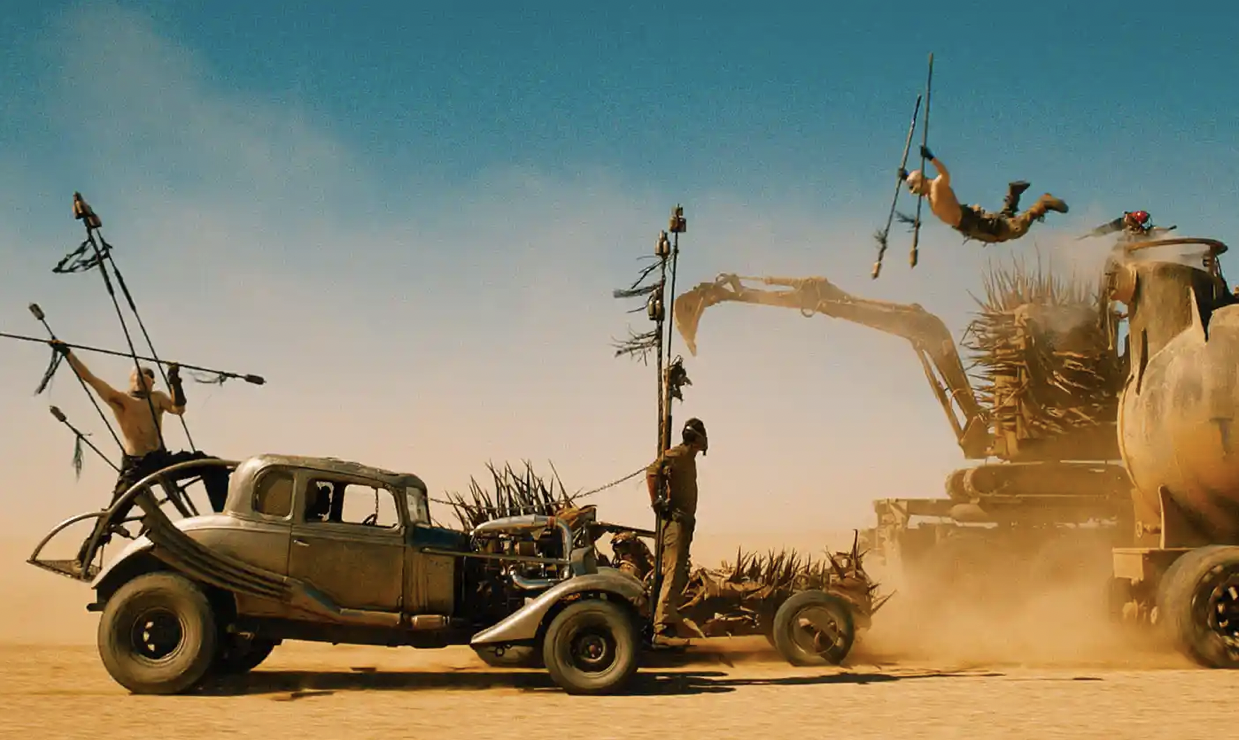
Excellent piece in The Guardian on a new book/oral history from the pop culture reporter for The New York Times, Kyle Buchanan about the making of Mad Max: Fury Road. The piece — “A fetish party in the desert’: the making of Mad Max: Fury Road– includes excerpts from more than 130 new interviews with key members of the cast and crew, including Charlize Theron, Tom Hardy, and director George Miller.
I’ve watched the movie half a dozen times and, like the author, didn’t realize the stunts were not CGI. They were real. My copy of the book is on the way.