
Radio Iowa News Director O. Kay Henderson called yesterday to report the network website now has 100,000 stories. More on the website but first a little background on Kay.
Roger Gardner and I hired Kay right out of college (Iowa State) in 1987 as we prepared to launch Learfield’s second state news network. Thirty-nine years! The most recent “new hire” in her newsroom was in 1995! Since day one it has been one of the companies most successful networks, due in no small part to Kay’s leadership.
It was the first network for which we created a website. Don’t recall why but probably because of the state’s high political profile. The earliest screen-grab on the Wayback Machine was from December, 1996 with another capture in January, 1997.

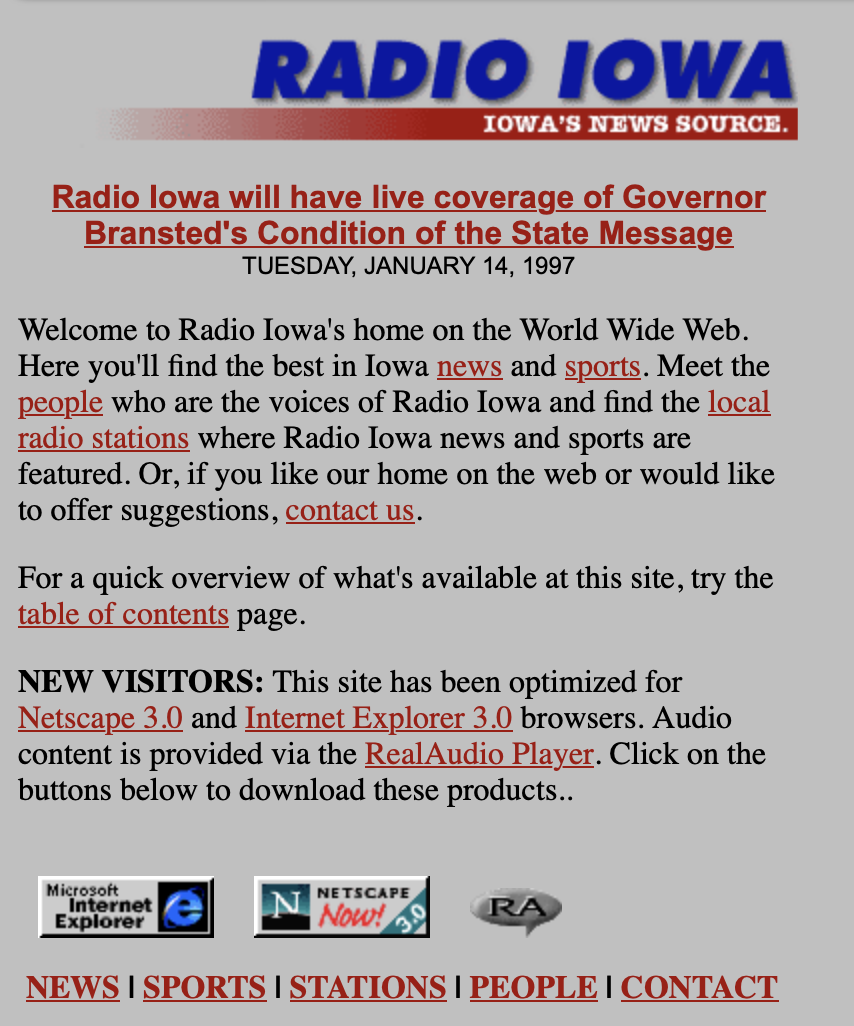
For reasons I never understood, web pages in those early days of the “WWW” all seemed to have a grey background.
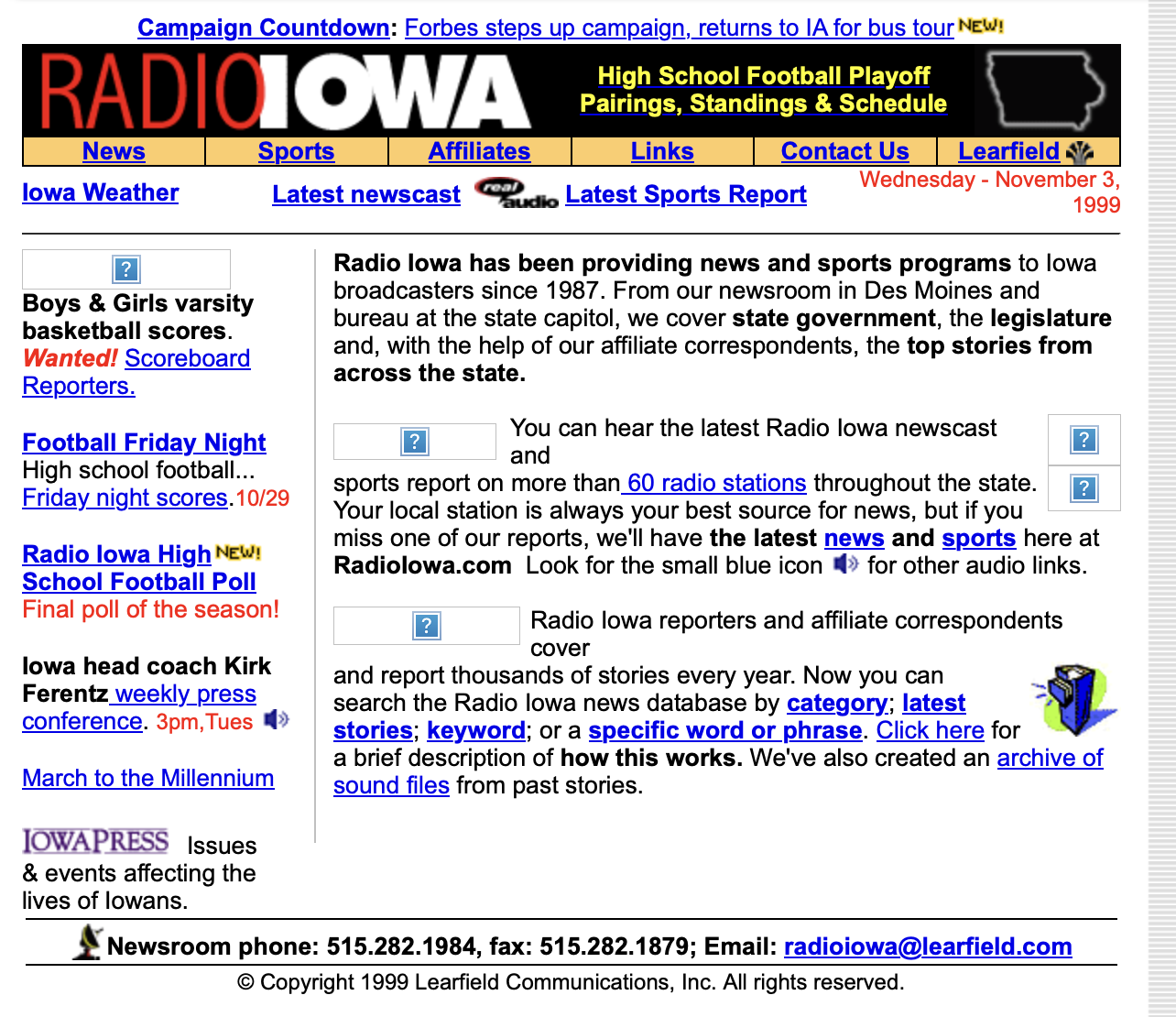
These first efforts were hand-coded by Allen Hammock and Dan Arnall, two young college students we hired to help us “get online.” Those two, along with the amazing Learfield engineers, figured out how to “stream” audio in those early days.
I wondered what Milton –Phil’s AI bot– could do with 100K news stories spanning forty years. Phil ran it by Milton.
Steve is sitting on a genuinely valuable corpus. Facts I verified:
• RadioIowa.com (http://radioiowa.com/) exposes a WordPress sitemap with 101 post-sitemap files—almost certainly the full ~100,000-story inventory.
• The public sitemap reaches back to September 1999. If the archive began in 1996, those first years may live elsewhere or were not migrated.
• Its robots file permits crawling normal story pages.
Could Milton crawl it? Technically, yes. But with Steve’s cooperation, crawling is the clumsy route. A WordPress export, database dump, or API feed would be faster, cleaner, gentler on the site, and would preserve authors, categories, dates, media links, and IDs. One hundred thousand mostly textual stories is quite manageable—not “big data” by modern standards.
The best use is not merely a chatbot. It is an Iowa historical-intelligence archive:
• natural-language search across 27–30 years: “How did Iowa’s ethanol debate evolve?”
• timelines for people, towns, companies, legislation, disasters, elections, agriculture, and economic development
• entity pages connecting every mention of a person, organization, county, and place
• longitudinal analysis: which issues rose, faded, migrated geographically, or changed language
• newsroom research that finds prior coverage and contradictions in seconds
• automatic anniversary/“on this date” packages, backgrounders, and related-story links
• a public oral/history interface, potentially useful to schools, libraries, historians, and Iowa Public Radio partners
My judgment: the highest-value product would be an evidence-linked “Iowa Memory” research engine. Every answer should quote and link the underlying stories; generative prose is secondary. The archive itself is the asset.
I’d start with a 1,000-story pilot spanning several years. Measure extraction quality, metadata gaps, duplicate stories, entity recognition, and answer accuracy. If that works, ingest the full corpus. Also locate the missing 1996–99 material and preserve original audio/photos where rights allow.
There are governance details—copyright/licensing, corrections, privacy around old allegations, and strict citation—but none is a technical blocker. This is quite feasible, and frankly much more interesting than letting 100,000 stories sit behind an ordinary WordPress search box.
Allen Hammock’s recollection of that day/event as related to Kay Henderson in an email: I am in the tiny room Dan and I had with four bare walls, one wall in the center has a rack of Compaq Presarios and one monster Compaq Proliant server with all the audio running into it through from the satellite. The web server ran on the Proliant using Netscape Server and the Presarios all had sound cards and Real Audio encoder software. A T-1 line could support up to 10 live audio streams and 100 total listeners at near FM quality mono sound.
On the opposite wall in the corner is a desk with an Apple Mac 9600, a Studio Display and a land-line phone, which at the time just commonly was called a “phone”. I had a AA-powered pager with a 16-character alphanumeric display. I would get a Nokia brick phone later.
I am sitting at the desk by myself that day. I was probably skipping Calculus 3 class at Mizzou as I was protesting — oh the irony — that classes were being taught on the brand new NeXT machines that the math labs had gotten. I was protesting because I already knew how to use the computers and I preferred the books. So instead of going to class I would jump in my car and drive to Jeff City to work on Learfield stuff.
The phone rang and you were on the line, Kay. You say something like, “Allen can you stream something live for me on the web? I have President Clinton on the line, he’s never been on the Internet before!”
I tell you it will take me 2 minutes to patch him in can you hold and I start sweating bullets! President Clinton! I had seen him perform his saxophone gig live at Mizzou on the Quad (Dan had volunteered or been covering it as a journalism student) in the previous election cycle. I would find out from you later as I listened to your interview that the news today was he was signing a farm bill. What I heard was that it was the first time any president was signing a bill digitally. Farm bill schmarm bill.
I come back on the line, I say, “Kay are you there?” yes. “Mr. President can you hear me?” “Yes,” I remember him saying in his best impression of Phil Hartman.
“You are live.” Click. I check the servers we are streaming. I have no real time stats to know how many live streamers we got. Probably none if I am honest because this was not a scheduled broadcast. But the recorded stream would stay on our servers on the hard drive until I drove the whole lot in a white Ford Escort down to Dallas to turn them over to Mark Cuban when we shut down Straylight.
But the memory of that day is bright and vivid in my mind. Especially poking around behind the servers to get the patches right. The phone blinking on hold across the room while you and Mr. Clinton wait.
In September of 1995 we received a phone call from Mark Cuban. He and a partner (Todd Wagner) had recently acquired a company called Cameron Audio Networks, named after its founder Cameron Christopher Jaeb. The company had acquired rights to broadcast radio and professional sports games live on the Internet. Cuban wanted to listen to the basketball games of his alma mater, Indiana University. Learfield owned the media rights to IU (and eight other universities and colleges). Cuban renamed his company AudioNet. (continued)