Poll: Internet more reliable than TV, radio news
ReadWRiteWeb
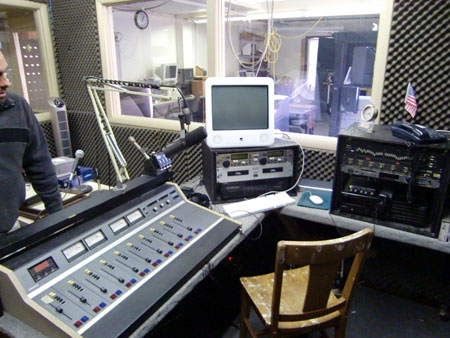
Sarah Palin is holding a rally in Springfield, Missouri, and radio station Hit 99 FM is streaming video live from the event. They could have made it easier to find but deserve props for the effort. I'm having trouble getting audio but perhaps that will change when the event gets underway.
Interesting that this is a music formatted station, not a news/talk'er. David Brazeal is there and might interview someone from the station. We'll post it here if he does.
PS: This is what we lovingly refer to as "a face for radio."
A few months ago I got a call from Brian Slawin. Someone told him I fooled around with streaming live video and he wanted some ideas on how to stream his daughter's softball games so family members could watch her play. He gave Qik and Kyte a try but wasn't happy with the results but he kept at it. This past weekend he packed up his laptop, webcam and Sprint cellular card and headed for the ball field.
"Initially, I was concerned that a wireless cellular card wouldn’t allow enough upload bandwidth to actually stream the signal, but it turned out that even at 100kbps upstream, the signal was rock solid and remarkably clear. My gear includes an HP Pavilion PC, the Sprint card, a Logitech QuickCam Vision Pro, a power strip with 1400 joules filtering and some other cables, etc…
Watch live video from Airshowguy @ Work on Justin.tv
"Turns out I got lucky…my Sprint signal was 5x5 and there was power right at the backstop plus an angled desk/bench that made for the perfect setup. I used the Justin.tv streaming system and it was tons of fun to have about a dozen parents/friends watch each game and join in the chat with Justin’s embedded chat feature. I made like a play-by-play narrator typing out what was going on…and every now and then playing “Joe Buck” for fun."
"I’ll need a better setup than just hanging the web cam from a couple of lanyards and a bag…when it got windy, or when there was a foul ball, the camera shook and I had to reposition it numerous times. Likely a tripod or perhaps a platform that is more securely attached to the fence and would allow for a higher angle is what I’m going to experiment with next."
Brian's company has some big plans.
"I can see a time where we’d actually hire broadcast teams (students in broadcasting programs in local high schools or colleges) to broadcast the games. We’ve already begun working with a softball tournament company on the East coast and are going to try and bring this forward for next summer’s tournaments in the New York, Pennsylvania and New Jersey area."
"But for now, I’ll continue to enjoy traipsing after my daughter this fall and into next summer as we travel to Junior Olympic softball tournaments throughout the Midwest. Be sure to visit Warcats18Gold.com for more information about the team and if you’re nearby, be sure to come by and say hello at the Eleventh Annual St. Louis Softball Showcase in Chesterfield, MO Oct 31 – Nov 2."
During my early radio days ('70s) there was tremendous pressure on the radio station to broadcast high school football and basketball games. We did some high school baseball but I don't know that we ever found air time for girls softball. There just wasn't enough time, staff or advertising support. And if one of the local radio stations didn't broadcast the game... you had to be in the stands.
No more.
This video was brought to my attention because the "reporter" is a former Learfield intern, Tyne Morgan. Some of you might remember Tyne from a little speed-texting video I posted a while back.
Big companies like Monsanto have always had the wherewithal to produce videos like this one. But then what? You buy time from a bunch of TV stations to air them? Pretty darned expensive.
Today? You create your own YouTube channel and hire someone like Tyne and you're off and running. You can bet Monsanto has one bad mamma jamma of a database/mailing list that can be sliced and diced to target exactly the people that might want to see this.
So, when companies can control their media/message from A to Z... what is the role of what we used to call "the media?" [via Journamarketing]
Had a chat with an acquaintance who now lives and works in another part of the country. He's a long-time radio news guy and he called to get my advice on how his newsroom can better take advantage of "new media" (which ain't that new anymore).
As he talked about his newsroom and the company he works for (a good one), it became clear there was no clear direction for making the transition from Old Media to New Media. And unlikely to be one. So what can he do?
First, what he cannot do. He probably cannot change (or provide) the larger online strategy his company needs.
But he can begin learning the skills he needs to survive. In no particular order:
To an old radio dog, all of this sounds like a lot more work than it really is. But here's the question I posed to my friend:
If your current job went away overnight, what would you do? Try to get a job at another radio station? A newspaper? TV station?
What kind of skills to you think they're looking for these days? Will it be enough to give them a cassette tape of your best work? Maybe a list of the RTNDA awards you've won?
The skills he learned in J-school are important. His many years of "radio" experience are valuable. But it's a new game, that demands new skills. You got 'em or you don't.
Chris Brogan observes "the bigger or older or more successful the company, it seems, the more difficult this experience" of finding the next new hit. An observation he feels applies particularly well to media companies.
Brogan would call his approach to this problem the "escape pod" model:
He ends is post with the Big Question: CAN media organizations put new crops into the ground without pulling up the roots to check how they are growing? [via David B.]
Terry Heaton takes a thoughtful look at the charge the media has a liberal bias. I've pulled two paragraphs from his thoughtful essay:
"I believe the press is inherently biased towards a liberal perspective, because educated people, among other things, are generally more exposed to the value of tolerance than those who are not. Chesterton wrote that “Tolerance is the virtue of people who don’t believe anything,” and that is a core component of conservative thinking. It’s not that conservatives aren’t tolerant; it’s just that it isn’t elevated to the status of core value as it is with liberals."
"One issue I do see is that because conservatives are predisposed to law-abiding and put faith in hierarchy, they are more open to direction from the top. In that sense, the qualities and character of the person at the top are critical."
"Conservatives ride the wind of the esoteric when it comes to certain issues, but liberals have their feet firmly planted on the ground and in the middle of those issues. In this sense, the two never talk with each other, because they’re not even in the same space."
Which reminds me why I decided to stop discussing politics. A vow I quickly broke but now renew. It's like getting off crack.
Terry Heaton encourages journalists to develop their personal brand:
"Let’s face it; the day is coming when independent journalists will offer their goods and services to media companies, instead of the companies actually employing them. This is already happening on a small scale, but I expect it will increase as fiscal pressures squeeze the life out of media companies. Hard-working independent contractors can make good money, and it will cost media companies less to purchase their work."
I'm not sure I need a strong brand at this point but --for better or worse-- smays.com is it.
Big time sports journalist Jay Mariotti has resigned from the Chicago Sun-Times:
"It's been a tremendous experience, but I'm going to be honest with you, the profession is dying,'' Mariotti said, "I don't think either paper [Sun-Times or Chicago Tribune] is going to survive. To showcase your work ... you need a stellar Web site and if a newspaper doesn't have that, you can't be stuck in the 20th century with your old newspaper.''
His bosses have a different take on things and you can read what they have to say at CBS2Chicago.com.
MEDIA WEEK: "Sprint Nextel subscribers will be able to listen to live radio broadcasts of National Football League games this season as part of new partnership between the wireless provider and sports league.
The live, cell-phone-accessible radio broadcasts—the centerpiece of the new NFL Mobile Live platform--will be available to all Sprint wireless subscribers who purchase a basic data plan as part of their services. In addition, as part of the agreement a select group of premium subscribers will be able to view live broadcasts of the NFL Network’s eight Thursday Night Football games on their phones starting on Nov. 6."
Hmmm. Here's one of several "take away's" from this story by Mark Ramsey:
"For some reason, many broadcasters confuse the term "content" with "the stuff that's on our air." When I use the term "content" I mean the material that's of serious interest to listeners. Stuff they will seek out. Not filler. Not commodities. McDonalds and NOBU may both offer "food," but that's where the similarity ends, and don't think for a moment the patrons don't know the difference.
In this case, the content is owned in its entirety by a third party - not a radio company. When it comes to professional sports play-by-play, radio is a distribution channel, not a content owner. Thus we will lose out to the owners of content in deals like this."
Our company does broadcasts for a whole bunch of big (and small) colleges. We've been streaming (via Yahoo!) for years and on satellite radio for the last few years. It seems inevitable that these broadcasts will go directly to phones, sooner or later. Stay tuned? Dialed in?
Lost Remote's Don Day looks at the strengths and weaknesses of local media at the war for local dollars gets hotter. Don't miss the comments. Good stuff.
The latest Pew biennial news consumption survey is out and offers no big surprises. Two new (to me) terms caught my eye: Integrators and Net-Newsers:
"Integrators, who get the news from both traditional sources and the internet, are a more engaged, sophisticated and demographically sought-after audience segment than those who mostly rely on traditional news sources. Integrators share some characteristics with a smaller, younger, more internet savvy audience segment - Net-Newsers - who principally turn to the web for news, and largely eschew traditional sources."
I certainly think of myself as "engaged" and "sophisticated," but long to be "younger" and "savvy." Sigh.
These surveys often make no mention of radio. I was pleased to see that radio is hanging in, at least against TV.
"Notably, radio news also is an important element in Integrators' news diet. Nearly half of Integrators (46%) listen to news on the radio during a typical day. While the internet is the main news source for Integrators during the course of the day, about as many in this segment rely on radio news as TV news during the day (32% radio vs. 36% TV news)."
The Big Question (assuming it is still up for question) is what happens when the Integrators have all gone to that Community Center In The Sky?
"No communication technology has ever disappeared, but instead becomes increasingly less important as the technological horizon widens." --Arthur C. Clarke
If you watch any TV or cable news, you hear references to this or that video on YouTube. It reminds me of the days when the big three networks referred something on CNN. YouTube is starting to feel like another network. NBC doesn't want to cover my speech? No problem. I'll just post it to YouTube.
My next thought was the similarity to public access TV. Let the record show I know almost nothing about public access TV. I think it works something like this:
The local cable company (or someone) sets aside a channel for the public to produce programming. I assume there is a local board or committee that manages the channel and decides what programming to air and when.
Putting Tivo aside for a moment, the public access channel is limited to 24 hours of programming each days. And to keep the math simple, let's say every program is an hour long and airs once a week. That's 168 programs a week. And many of those would "air" in the middle of the night.
I think it would be difficult to fill that much time. And what if I had something that was only 5 or 10 minutes long?
Here's my question: Why won't YouTube (and similar services) make public access television obsolete? [This is where I show my ignorance of PATV] If local relevance is the raison d’etra of PATV, why not just invite the people of your community (or people who visit your community) to post their videos to YouTube and tag them with the name of the city/town?
But wait, what about our live coverage of the weekly city council meeting? It runs 2 hours or longer and YouTube limits videos to 10 minutes.
Hmm. I guess I'd stream it on Ustream and then pull "highlights" and post those on YouTube.
I expect the Big Question would be, "What about all the people who don't have computers and access to the Internet?" For the answer, see: "What About People Who Don't Have TV Sets?"
Don't misunderstand. I'm not suggesting for a moment that public access TV isn't a good or necessary thing. There must be people who watch it or it wouldn't exist. It just feels like one of those things --like classified adds-- that would work better and cheaper online.
My friend Jeff knows a LOT about public access TV and I encourage him to comment and help me understand how technology is evolving in this area.
From Ars Technica article: "A political spat erupted in Washington, D.C., earlier this month over rules governing how members of Congress may use the Internet. House Republicans argued that proposed changes to the rules amounted to "new government censorship of the Internet," while Democrats said the charges were exaggerated. Whichever side is right or wrong, the fact remains that current rules governing official communications prohibit members of Congress from using video-sharing or social networking sites like YouTube, Flickr, or Facebook. As a result, many House members, including Speaker Nancy Pelosi (D-CA), are currently in violation of the rules.
Rep. John Culberson (R-TX), a pioneer in using new media to communicate with constituents, sounded the alarm over the new rules via Twitter. Culberson has made a name for himself twittering from the House floor, broadcasting live video from the White House using Qik, and hosting regular "town hall" meetings using live video-streaming and chat on Ustream.
In a later statement, Culberson argued that new media should not be treated any differently than old. "When I am interviewed for a newspaper article or a television story, or have a conversation on a radio show, my interview/conversation is going to appear in the same publication/broadcast as a campaign or commercial ad," he said.
Is there any greater power than being able to control information? The first order of business when staging a coup d'etat is take over the newspapers, radio and TV stations. Well, first you kill the president... then you take control of the media.
It bums me that the Dems seem to be the sand in the gears on this one but it doesn't surprise me. And that stuff about "we don't want commercials next to videos from Congress" is pure horseshit.
NYTimes.com: "When Congress adjourns, so do C-Span’s live broadcasts because the sole cameras that record the sessions of the Senate and the House of Representatives are controlled by the members of Congress.
On Friday, when several dozen Republicans decided to stay on the House floor and discuss energy legislation after the House adjourned for a five-week summer recess, the cameras and microphones were turned off. So the first source of video was a congressman who streamed live pictures to the Internet using his cellphone camera."
Just one more (small) example of how things are changing. If any feature prompts me to break down and buy a real mobile phone, it will be the ability to stream live video when there's no wifi.
When I was a little boy, I would sometime go with my dad to the radio station where he worked. I was fascinated by the Associate Press teletype. I would stand before it, watching the words clatter across the page. I didn't pay much attention to the news... it was the mechanics of the process. A big box of fan-fold paper fed the thing and every so often someone would come by, rip off a long strip and take it away.
Years later, when I got a job at that same station, I became more familiar with the AP teletype. It was the primary source of non-local news we relied on to fill newscasts and sports reports. If it broke --and it broke often-- we were screwed. The nearest tech was in St. Louis and they did NOT like driving to Kennett-bumfuck-Missouri to fix the things. So they got pretty good at phone support.
As I hop from link to link, web page to web page, I sometimes think of the endless sheet of paper that streamed from that old teletype. And how dependent we --and our listeners-- were on the reporters, editors and technology of the Associated Press.
And how much of the news that spewed from the machine was never used and thrown away. Maybe 80 percent? No doubt we had listeners that would have loved to hear (read?) every story that came down the wire. But we had no way to give it to them in a 24 hour day.
If you work at a radio station today, you have immediate access to... well, everything. News, images, video. And, increasingly, so do your listeners.
All of this just reminds me how completely distribution defined what we were doing. AP reporters fed stories to bureaus where editors fed them down wires to radio stations, newspapers and TV stations... who "fed" them to their listeners/readers/viewers.
As I look around the coffee shop where I'm writing this, there are several laptops, open to an ocean of information far richer than the trickle that came out of those teletype machines. We're "feeding" ourselves these days and the menu is rich indeed.
I am part of the first TV generation. Thousands of hours of my life were spent watching. Just watching. These days, like many others, I spend many of my hours online, creating, sharing and consuming media. Clay Shirky explains why this "social surplus" is a very big deal:
"Here's something four-year-olds know: A screen that ships without a mouse ships broken. Here's something four-year-olds know: Media that's targeted at you but doesn't include you may not be worth sitting still for. Those are things that make me believe that this is a one-way change. Because four year olds, the people who are soaking most deeply in the current environment, who won't have to go through the trauma that I have to go through of trying to unlearn a childhood spent watching Gilligan's Island, they just assume that media includes consuming, producing and sharing."
If you are in any way connected to the business of "media," you need to read --and understand-- what Mr. Shirky has to say.
I had a feeling Henry might enjoy making a few videos. He's a gifted digital artist (that's a photographer who doesn't have to take assignments) but has always focused on still images. The video above (4 min) is a walk around the lake at the Prairie Garden Trust with Pete, Sam and Boots.
I think this is only Henry's second video and I predict we'll see some very cool stuff once he gets the hang of a different medium.
My favorite part is when Sam stops to take a leak.
I "follow" Barack Obama's Twitter feed. If you don't know what that means, it's okay (unless you happen to be a journalist). A few minutes ago the campaign "tweeted" that the senator was getting ready to speak in Springfield, Missouri and I could watch it live by clicking the included link.
It took me to the "live" page on the Obama website where a USTREAM player was feeding live video. As I write this there are 830 viewers. Only a fraction of the number watching on the cable news channels that might be airing this speech.
I mention this only because no "traditional media" were necessary to make this happen. The Obama campaign has an email address for each of the millions (?) of people who have contributed to his campaign. We all got a ping that he was about to speak.
[901 viewers]
I think this is huge. Sure, a campaign still need MSM to get elected. Today. Will that be as true four years from now? Will it be true at all 8 years from now?
[1,045 viewers]
Of course it is not just the live stream. This speech --and all of the others-- will be available from now until election day. And beyond?
[1,095 viewers]
Lost Remotes Corey Bergman predicts the iPhone (and the apps that will be written for it) will have huge impact on local news and information:
"...the location-aware phone (and similar phones that follow) will become
the go-to devices for local information. In fact, I believe local
information ultimately will be consumed more on mobile than PCs."
Where have we been getting our local information? Oh yeah, radio.
Writing in Time Magazine, James Poniewozek has an interesting take (The Beltway-Blog Battle) on the passing of Tim Russert.
"...the press lost its most authoritative mass-market journalist, just as it is losing its authority and its mass market."
The New Meida vs. Old Media argument got tiresome a long time ago, but Mr. Poniewozek offers a fresh take. A few paragraphs to wet your whistle:
"In their original division of labor, the old media broke news while the blogs dispensed opinion. But look at two of the biggest stories of the Democratic primary: Barack Obama's comments that working-class voters are "bitter" and Bill Clinton's rope-line rant that a reporter who profiled him was a "scumbag." Both were broken by a volunteer for the Huffington Post website, Mayhill Fowler.
Traditional reporters were aghast at Fowler's methods--the Obama meeting was closed to press (she got in as a donor), and Fowler did not identify herself when speaking to Clinton. But mainstream media had no problem treating the scoops as big news; if she had overheard both quotes in the same way but told them to a newspaper instead of publishing them, that would have been considered a coup.
The case against Fowler, in other words, was about process and credentials, not content. If sources stop trusting us, reporters asked, how will we do our jobs? But however sneaky her methods, Fowler's stories prove that one reason sites like Huffington have an audience is the perception that Establishment journalism has gotten better at serving its powerful sources than its public. Fiascoes like the Iraq-WMD reporting gave many the impression that the old rules mainly protect consultant-cosseted public officials who need protection least."
[For more on the Mayhill Fowler story, here's a bit of audio with Arianna Huffington, speaking at Guardian News & Media's internal Future of Journalism event on 18th June 2008.]
Mr. Poniewozik poses this rather rude question regarding MSM: "...if 3 million people read Drudge and 65,000 read the New Republic, which is mainstream?"
Guardian.co.uk: "The Huffington Post is planning to expand into local news across the US, founder Arianna Huffington said last night, beginning with a site edited for the community of Chicago. Huffington said the Chicago site would aggregate news, sports, crime, arts and business news from different local sources as well as contributions from bloggers in what will be the first of a series of projects in "dozens of US cities". The Chicago site will initially be curated by just one editor."
I'm a bit bothered by "aggregate news, sports, crime, arts and business news from different local sources." This suggests (to me) that a HuffPo editor in St. Louis, should they expand to that city, would link to stories from the St. Louis Post-Dispatch website. Or even our statewide news network, when we do a story with St. Louis relevance.
Which is way the web works, of course. I'm not quite sure what about this plan bothers me. Maybe it's: What can a single Huffington Post editor provide that the St. Louis Post-Dispatch website cannot?
Is it a matter of putting an editor in each of the top 50 markets... have them aggregate stories and links to local news sources... and building an online audience that is smaller while accomplishing all of this at a fraction of the overhead?
Or is it that the people behind the Huffington Post just get the web better than most of the other guys?
That was part of a promo I heard on MSNBC tonight. First time I noticed the phrase, "embed video." Even the networks are figuring out it's a good thing to have your video embedded in millions of blogs and websites.
I'm sure there is still a lot of "...no, no! We want them to come to OUR website!" But the web IS the network now and your affiliates are are all those blogs.
"In the next 10 years, the whole world of media, communications and advertising are going to be turned upside down -- my opinion. Here are the premises I have. Number one, there will be no media consumption left in 10 years that is not delivered over an IP network. There will be no newspapers, no magazines that are delivered in paper form. Everything gets delivered in an electronic form." [from an interview -video/text- at washingtonpost.com]
Mark Halperin and the folks at Time have their digital shit in one neat pile. Check out this exclusive video with David Axelrod, just after learning that the Associated Press has declared that Obama has secured the majority of delegates to the Democratic convention and will win the nomination.
Looks like Halperin is shooting with a small, hand-held camera. No mic (except for the camera), a little jerky but talk about immediacy.
There are just so many things I like about The PageCast, I'm not sure where to begin. First, what is The PageCast.
It's a 60 second video by Time Magazine's Mark Halperin, previewing the three stories that he thinks you should be watching for today. You'll find it on the top/right of The Page. Big whoop, right? Okay, here's some of the things I like about this simple idea (and this particular PageCast):
The news directors of our radio networks would be great at this. And their listeners/readers/viewers would eat it up.
UPDATE: My buddy Kay reports that Mark Halperin records PageCast between 7-9 a.m. (usually), wherever he happens to be and in whatever he happens to be wearing. If he's on the West Coast, he usually records them at night. He thinks of what he wants to say just before he begins recording (or in the shower or at the gym), on his MacBook Pro (edits with iMovie).
The idea was prompted by the desire to put video on The Page, while keeping it easy to produce and watch. Just as I suspected. Simple idea, well executed.
Jerry Del Colliano shares a few ideas on "next generation radio" he'll be presenting to an interactive session for radio executives next month:
"My view is that terrestrial radio is now a destination entertainment medium for available listeners - older members of Gen X and the baby boomers."
"...there is no need to produce 24/7 programming online. ... But the radio station of the future may only provide three hours of programming a day – that’s right, a day – and deliver it on a cell phone or mobile device.
"Podcasting will be the new radio for Gen Y."
"The successful content provider in the future will have to unlock the genius of Steve Jobs in understanding a generation they are not in – and Jobs, arguably, knows Gen Y better than they know themselves."
"In the past, a radio station had to be on-air, all the time and doing the same format over and over again. But in the future, new media will require radio broadcasters who want to play in this arena to be many things for which it does not presently have skills."
If you're interested in where radio might be headed, I encourage you to read the full post. Companies that provide programming to radio stations -- like our company-- are sure to be affected by the same forces. Are we ready?
Proto-blogger Dave Winer thinks the real problem revealed by Scott McClellan's new tell-all book is that the press was complicit in beating the Iraq war drum:
"But corporate-owned media isn't interested in helping us make decisions as a country, they're only interested in ad revenue. That's why it's so important that we're creating new media that isn't so conflicted, and why the question of whether bloggers run ads or not is far from a trivial issue."
When it comes to national media, there really are not that many outlets that need to be manipulated. Four TV networks; maybe that many cable news channels; a handful of newspapers with national reach. If you can juke them, you've got a lot of the country juked.
The sooner their influence is diminished, the better. There will no longer be even the illusion of "national media" and people will have to work (a little) at being informed. Sure, the willfully clueless will still head for blogs and news sites that confirm their view. But the rest of us will stop trusting (if we haven't already) news organizations that are child's play for political spin-miesters.
I'm still testing the flip video camera under different lighting conditions. This clip runs just over a minute and looks a little washed out (?) to me. And the flickr stream tends to stop-start. Not sure if that's the flip or flickr.
Our IT guys found a fun way to embarrass one of the new interns... AND share a Big Cookie.
Yes, I am aware of how many video cameras I own. No, I do not need another one. I purchased a Flip video camera ($150.00) because I was so intrigued with the idea of a small, inexpensive camera designed to do just one thing. Video.
They even did away with the USB cable and SD cards. You plug the Flip right into the USB port with a little... flip-out USB connector.
The one I got records an hour of video. I think the $100 model does 30 min. Check the website for specs.
Does the Flip take better video than my little Casio. Probably not. Is it as handy as a pocket on a shirt. Yes, indeedy, and it's less than half the price.
I'm not sure what I'll do with mine. I just wanted to see if this device is a cool as I've been hearing and reading. I think it might be. Toss it in your beach bag or your purse and go. Hit the red button and you're recording. Makes the Sony Camcorder seem like a big old pain in the ass to lug around.

Uses two AA batteries and works with Mac or PC.
Warning: You'll hear me talking baby talk to our Golden Retrievers. Runs 90 sec.
I gotta face it. I'm a radio guy. I have neither the face nor the concentration for TV. That's my take-away from this morning's live webcast from the Coffee Zone. Just too many things to keep track of. Watch the chat stream, monitor the audio (which is several seconds behind what is being said), look at the camera... whew!
As I replayed our half-hour chat I found myself thinking, this would have been much easier (and less painful for all concerned) if we'd just streamed the audio. Pictures added nothing to our little experiment.
We had 9 or 10 people watching, giving us encouragement in the chat room like parents at a grade-school production of 12 Angry Men, whispering our lines from the wings ("Turn up the mic!").
I think I'm going to look for some sort of live event for the next webcast. Perhaps the 4th of July parade or something. Stay tuned.
I finally figured it out. Sort of. If you can count stumbling on the right configuration and being unable to do it twice in a row "figured it out." But I now know that it can be done. (The background image is lobby of our new offices in Dallas.)
My setup is pretty crude. Two flood lights from Lowe's and a few yards of green felt on the basement wall. It's pretty clear that lighting is critical for this effect and I might have to come up with more or better lights before I try a video background.
And streaming (over the wifi) from the basement isn't gonna cut it. Too slow. Gotta get an Ethernet jack down here or set up in the upstairs office. But hey, that's what weekends are for, right? I'm proud to say I PayPal'd the CamTwist guy $50. It's worth far more than that.
I've been trying to assemble the best combination (for me) of hardware and software for streaming live video. The ease-of-use and price (free, for now) of Ustream.tv has made it possible for any nimrod to play in Wayne's World.
MacBooks, with the built-in iSight camera, make live video just that much easier but sometimes you want to point the camera the other direction, so an external webcam enters the picture (so to speak).
This weekend I've been playing with the iMage webcam from eCamm. It doesn't look like much but --for $60-- it delivers a very nice image and you can put it in your pocket. I've mounted mine on a small tripod.
The final --and most exciting-- piece of the puzzle has been a freeware app called CamTwist. CamTwist works very well with Ustream.tv and comes with an amazing set of features and a UI that's intuitive and easy to use. If you're interested, I recommend this short video, but let me mention some of the cool things CamTwist does:
There you have it. An inexpensive webcam; a feature-rich piece of freeware; and --for now-- a free streaming solution at Ustream.tv. Do we have any program that's especially compelling or useful? No. But that will be the easy part. And when it comes up, we'll be ready to share it with the world.
The guys at Podcasting News share highlights from a new report by Universal McCann that suggests new media is becoming mainstream media. Among the research highlights:
"Blogs are a mainstream media world-wide and a collective rival to traditional media (184m bloggers world-wide, China has the largest blogging community in the world with 42m bloggers) – 73% have read a blog, 45% have started a blog."
Key social platforms mentioned in the report: Blogging; Micro Blogging; RSS; Widgets; Chat Rooms; Message Boards; Podcasts; Video Sharing; Photo Sharing.
If you're in media now and these terms are foreign to you, or seem silly and pointless, the Cluetrain doesn't stop here anymore.
If you're up and online this Saturday at 9:30 a.m. Central, try to catch a few minutes of our live webcast from Yanis Coffee Zone here in Jefferson City. It's one of those "we're doing it just because we can" events. Taisir (Owner and Proprieter) is gonna set up a table in a corner and George Kopp and I will plug in the video camera and shoot the breeze.
If you want to chat, you need to a) create an account at UStream.tv or b) IM me at smaysdotcom. We'll probably go for 30 min or so, unless we start having a lot of fun. If you don't see any live video it means we screwed the pooch and will have to post some lame-ass excuse. We'll have the video player front and center here at smays.com.
On a typical day, we get about 300 visitors here. I'd like to see how many folks we can have watching at any one time.
Amy Gahran is a former full-time journalist, editor, and managing editor. Today, her work mainly involves conversational online media (weblogs, forums, wikis, e-mail lists) as well as feeds, podcasting, and e-learning. Here are a couple of excerpts from her recent post at E-Meida Tidbits:
"I've been getting quite aggravated at the close-minded and helpless attitudes I'm still encountering from too many journalists about how the media landscape is changing. I realize that right now is a scary time for journalists who crave stability. I have immense sympathy for good, smart people (many of whom have families to support and retirements to plan) who fear the unknown. Many of the news orgs that have sheltered and supported these journalists as they ply their craft are crumbling due to their inability or unwillingness to adapt their business models -- leading to layoffs, buyouts, attrition, dwindling resources, overwork, and general demoralization.
I also know -- first hand -- that the prospect of learning new skills can be daunting. Plus, many of us have spent lots of money on j-school and many years in professional journalism honing our writing and reporting skills. We don't want to learn how to think like an entrepreneur, or an information architect, or a community manager. We just want to keep doing what we know how to do; we didn't sign up for all this extra stuff."
This is an insightful post, worth a full read. (Shirts available in S, M, L, and XXL)
That's one of the findings of a nationwide Harris Poll of 2,302 U.S. adults surveyed online between January 15 and 22, 2008 by Harris Interactive.
"Looking at the press in general, over half (54%) of Americans say they tend not to trust them, with only 30 percent tending to trust the press. Just under half (46%) of Americans say they do not trust television, while one-third (36%) do trust them. Somewhat surprisingly, Internet news and information sites do slightly better as a plurality of Americans (41%) trust them while just one-third (34%) tend not to trust them. And, radio tends to do best among Americans as 44 percent say they tend to trust it and one-third (32%) tend not to trust radio."

As for "trusting radio," are they referring to radio news or radio in a broader sense (talk shows, etc). And why does radio (and the net) earn higher trust than TV and newspapers?
I took a stroll around the office today with the Poor Man's Steadicam. Following the nausea-inducing tromp through the woods, I wanted to see how the tool worked under better conditions. Hard to judge without a side-by-side look, but I think this is smoother video than I could have achieved by just holding the camera. Note the second or two immediately following the transition where I'm going down some stairs.
Newspapers are putting an ass whuppin' on radio stations online. Maybe they have more people, more money... whatever. Your honor, as Exhibit A I offer this video from JournalStar.com (Lincoln, NE).
David Burge isn't Comedy Central funny, but he's local celebrity funny and I find that even more charming. This trip to a minor league hockey game is fun and Mr. Burge is endearing (I hope this doesn't read as gay as I think it will). And someone did a nice job editing the video.
Google News now allows you to localize a section of the stories. Scroll down just beneath the fold for the box to type in your city or zip code. I plugged in my local zip code for Jefferson City:
“This is pretty huge, folks, and it spotlights the need for everybody in the local news business to adopt best practices when it comes to unbundled distribution,” writes Terry Heaton. True enough, as Google News ranked #9 in Nielsen-Netratings for December — higher than USAToday.com and WashingtonPost.com.
If you're a local news guy and look at this and say, "Ah, but they missed some stories!" ... you're missing the point.
Wisconsin State Journal: "The two candidates for Wisconsin Supreme Court will debate for the first time today -- but it won 't be face to face. The candidates will square off during a one-hour Internet radio debate hosted by a UW-Milwaukee student.
The debate is thought to be the first of its kind in a Wisconsin political race, said Kyle Duerstein, the journalism student who is hosting the program. Listeners will be able to hear the candidates debate and call in with questions. It will be the first forum featuring both candidates."
I'd love to know the back story on this. Was there no interest in such a debate by mainstream media? Did Mr. Duerstein just ask the candidates and they agreed? [Thanks, Jackie]
Update: WRN News Director Bob Hague talked with Mr. Duerstein about the debate.Download/Listen to interview (MP3)
Doc Searls says the Net makes radio and TV transmitters obsolete the moment high-enough-bandwidth wireless connectivity becomes ubiquitous.
"We’re one good UI away from the cell phone becoming a radio. (Thanks to the iPhone, it already serves as a TV.) And we’re one smart cell company away from radio- and TV-as-we-know-it from being replaced entirely -- or from moving up the next step of the evolutionary ladder. Public broadcasters know that. That’s one reason they now call themselves “public media”, a move that separates the category from its transport methods.
Will this someday be an issue for our networks? Radio Iowa. Wisconsin Radio Network. Nebraska Radio Network. Time will tell.
Lost Remote's Cory Bergman on why most TV stations haven't done well online:
"I’ll give you these four reasons: 1) lack of investment in people and technology 2) unwillingness to take necessary risks 3) TV-driven power structure which results in the inability for web management to quickly allocate resources as they see fit and 4) a bizarre addiction to brand consistency, which limits creative ideas up and down the organization."
I think these apply to most "old media" companies. Brand extension is not always the way to go.
Will we still get carpet bombed by mindless 30 second commercials in the future? (And by future I mean a couple of weeks from now.) Seems unlikely, but how will savvy marketers reach --and more importantly-- engage us? How do you "reach people who are so media-saturated they block all attempts to get through."
Perhaps with alternate reality games (ARG's). That's the subject of a fascinating article by Frank Rose in this month's Wired Magazine (Issue 16.01).
"The initial clue was so subtle that for nearly two days nobody noticed it. On February 10, 2007, the first night of Nine Inch Nails' European tour, T-shirts went on sale at a 19th-century Lisbon concert hall with what looked to be a printing error: Random letters in the tour schedule on the back seemed slightly boldfaced. Then a 27-year-old Lisbon photographer named Nuno Foros realized that, strung together, the boldface letters spelled "i am trying to believe." Foros posted a photo of his T-shirt on the Spiral, the Nine Inch Nails fan forum. People started typing "iamtryingtobelieve.com" into their Web browsers. That led them to a site denouncing something called Parepin, a drug apparently introduced into the US water supply. Ostensibly, Parepin was an antidote to bioterror agents, but in reality, the page declared, it was part of a government plot to confuse and sedate citizens. Email sent to the site's contact link generated a cryptic auto-response: "I'm drinking the water. So should you." Online, fans worldwide debated what this had to do with Nine Inch Nails. A setup for the next album? Some kind of interactive game? Or what?"
I'm not a gamer. At all. But I love shit like this. Reminds me of the viral video snippets in William Gibson's Pattern Recognition. The Wired article is well worth the read.
From Terry Heaton's PoMo Blog:
"Advertiser Perceptions latest survey of 2,047 ad executives (published twice yearly) — as published by Online Media Daily — reveals growing pessimism among ad buyers about traditional forms of advertising. I view this study as significant, because it speaks directly with people who are making decisions about spending money."
Only newspapers face a smaller increase and larger decrease than radio? [Emphasis/red from original post]
Mark Ramsey (Hear 2.0) asks how long before mobile phones in the U.S. look like this Nokia phone available in Europe.
As I watched the video demo, I imagined listening to a Missouri Tiger "broadcast." Or an all-news channel from one of our state networks. Ramsey's headline says it all.
I should have guessed the Google/YouTube guys would be all over the Iowa Caucuses. They've hooked up with The Des Moines Register, arguably the most powerful media outlet in Iowa, to create a YouTube channel:
"Document your caucus experience from start to finish. We want to show the nation what the caucuses are like, so bring your video camera along with you and give an on-the-ground view of your local caucuses. You can also add your own commentary or interviews with people just after the caucuses, offering their reflections on what took place."
I had to believe bloggers and podcasters and YouTube'ers would be all over this event but wasn't sure if cameras would be allowed. They are.
"Of course - these are our caucuses, and this a great opportunity to show the nation what they're like. Just be sure to be respectful of other caucus-goers and to make sure that your video footage is not a distraction to what's taking place."
And Google Maps is doing something special. but I'm not sure exactly what or where to find it. I'll update this post. If I had to guess it would be a map with all the caucus precincts, updated throughout the evening.
As I watched a couple of the videos, I was reminded of something I used to hear/say back during the early days of the net. Nobody will watch all of these. Somebody will watch each of these.