
“I am pro-abortion like I’m pro-knee-replacement and pro-chemotherapy and pro-cataract surgery. As the last protection against ill-conceived childbearing when all else fails, abortion is part of a set of tools that help women and men to form the families of their choosing. I believe that abortion care is a positive social good. I suspect that a lot of other people secretly believe the same thing. And I think it’s time we said so.”
Category Archives: Health & Medicine
Beyond Chicken
 Today I tried my first Beyond Meat product (Beyond Chicken!). Sautéed in a little oil. I was impressed. Look, smell, texture, flavor… damned close to chicken. I gave it an 8 out of 10 (close enough). I decided to give it a try after reading an article in Wired that talked about reverse engineering “animal flesh” in the lab.
“Replicating the flavor of animal flesh is just a matter of gathering certain amino acids, especially the yummiest acid of all, glutamic acid, the key component of monosodium glutamate, or MSG. (In the brain and nervous system, glutamate is a critical neurotransmitter; its taste, umami, is one of only five we know of that the tongue can perceive.) Any decent flavorist can whip you up a brew that tastes like roasted chicken with little more than hydrolyzed vegetable proteins and yeast extracts, using equipment from a high school chem lab.”
A (hypothetical) question for meat eaters. What if someone could create a product that was indistinguishable in every way from animal flesh. Something that could fool you in a blind taste test. And let’s say it cost the same (or less) and it was less harmful to the environment that traditional meat production. Would you eat it?
Ideal weight
When I started eating plants (instead of critters) a year ago, I pretty quickly lost about ten pounds (from 155 to 145). Friends still comment from time to time but my physician is fine with my weight and I feel good so I don’t give it a lot of thought. But this post on the Personal Capital blog made (what I thought were) some interesting points.
If you take a look at the weight for the top tennis players, they pretty much all fit in the weight chart ranges above. And if you look up 6 foot tall NBA guards such as Allen Iverson, Aaron Brooks, Luke Ridnour, Sebastain Telfair, and TJ Ford, they all weigh between 155 – 167 lbs as well. Of course none of us are world class professional athletes, but at least we know the charts have veracity.
According to a Gallup Poll, American men are weighing in at an average of 196 pounds today — 16 pounds more than in 1990. The average weight for women jumped 14 pounds to 156 pounds over the same period (neither sexes have gotten much taller since). Given the average height for an American man is 5′ 10″ and the average height for an American woman is 5′ 3″, Americans on average are 20-35 pounds heavier than the ideal weight.
According to the “ideal weight” chart in the post I’m on the low end for my body type (146- 157). Some might consider those ten pounds “head room,” but I prefer to think of them as “ass room.”
Plant Strong

Yesterday I concluded my 30 day experiment of eating only plant-based foods. No meat, no poultry, no dairy. I’ve tried to avoid the word vegan because it’s something of a loaded word. A big turn-off to a lot of people. I thought I’d share my reasons for trying this and a few of my experiences over the past four weeks.
The spark for this little adventure was my nephew, +Ryan Mays. He’s followed this life style (it’s more than just diet for him) for a couple of years and his enthusiasm was infectious. I didn’t eat a lot of meat anyway so I decided to see if I could eat plants only for a month.
I had a vague awareness of the health benefits of cutting out red meat but I’ve never been overweight and I’m in good health, so I wasn’t especially motivated by health considerations.
As I began this project(?), I discovered the ethics of eating animals was an important consideration for me. I feel better knowing I’m not (knowingly) contributing to the suffering of other creatures. I’ll hasten to add, this is a personal decision and I make no judgements about how others eat and live.
I’ve lost about 8 pounds since starting this but have more energy and a heightened sense of well-being.
I’ve found it surprisingly easy to find plant-based alternatives to meat, poultry and dairy. I’m eating lots of fruits, fresh vegetables and nuts. I was never a big milk drinker and now have soy milk or almond-coconut milk on my cereal. I made some vegan cornbread that was delicious and some oatmeal cookies that were not.
If I strayed, it was rare. Some bread or pasta that contained some dairy product. I didn’t sweat those much and don’t intend to going forward. And I’ll get smarter about how to eat.
Two weeks in I was thinking, “I can do vegetarian but not vegan.” But by the third or fourth week, I started thinking I could make this a permanent change. To the extent anything is permanent. So, now I can stop counting.
How Apple accidentally revolutionized health care
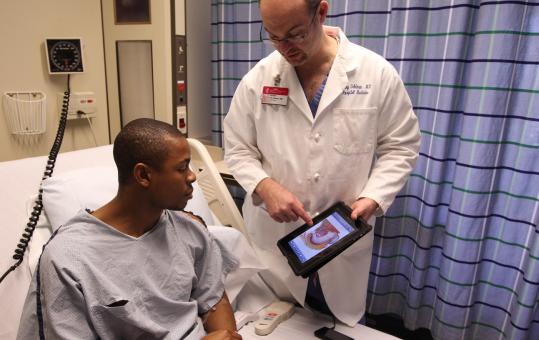
“A study by Manhattan Research in 2011 found that 75% of physicians owned at least one Apple product. Vitera Healthcare’s 2012 survey of health-care professionals backed up this high number. The company’s study found that 60% of respondents used an iPhone and 45% owned an iPad.”
“Yale University’s School of Medicine even did away with paper materials for training upcoming physicians. The school provided iPads and wireless keyboards to all of its medical students. Other schools followed suit.”
“By April 2012, the (Apple) App Store included more than 13,600 health-related applications.“
Motley Fool
Virtual reality environments for the elderly
Is anyone creating virtual reality games/environments for the elderly? I’m not a gamer but each time I happen on some video a new game, I’m stunned by how good the graphics have gotten. I assume all other aspects are improving as well.
Today I can outside and romp and play with the other kids but someday that might not be the case. And I might be in an assisted living facility or whatever they have in the far, distant future for people who can’t care for themselves.
Could a clever person create a custom virtual environment for me. I have thousands of photos, hundreds of videos and many thousands of blog posts and tweets and such. A person could know a lot about my past and interests and use that data to create something amazing.
Instead of playing grab-ass with Mrs. Henson down in the day room, I could jack in to Steve World. Hell, in 20 years, the hardware and software will know things about my cognitive state and compensate where needed.

There’s a pond at the bottom of the hill on which we live. On nice days I enjoy sitting at the edge and watching the geese. I’ll bet you that could be created with amazing accuracy. Even “get up and take a walk” around the pond (after I can no long walk anywhere). I’ll hear the geese and the wind in the trees and maybe smell the grass.
This might sound sad and creepy to some, it does to me a little. But aske me again in 20 years.
Scott Adams: Knowledge is Health
Scott Adams tells us 50% of second opinions from doctors contradict first opinions? And that 80% of the findings in medical literature are wrong.
“A new company called Metamed offers to be your personal medical researcher. For a fee of $200 per researcher per hour, with a $5K minimum, you can make sure the full force of science is on your side. Metamed analyzes the medical literature and tells you which study results about your condition are reliable and which are not. They assess the value of various diagnostic tests, and create a map of all possible medical correlations. It’s the sort of thing your doctor would love to do for you if he had the resources.”
And those Google glasses everyone’s making fun of?
“I can also imagine a time in which Google Glasses will observe all of your food choices during the day and keep a running record of your nutrition. When you stray from a healthy diet, your glasses might start suggesting a salad. When you don’t exercise all day, the glasses might suggest using the stairs instead of the elevator. For all practical purposes, a human with Google Glasses and a smartphone is already a cyborg. And your future cyborg half will do a better job of keeping your organic parts functioning than you are doing on your own.”
UPDATE: Metamed went out of business in 2015
Medical scenarios for Google Glass
- An emergency responder arriving at a motor vehicle accident is able to live stream to the emergency department the status of the patients and the associated trauma suffered to a patient. The ER is then able to assemble and prepare for a patient’s emergency treatment.
- A surgeon live streams to residents and students a live surgery–so that they can see what work goes into a medical procedure first hand.
- A visiting nurse seeing a patient in their own home video records and captures images of the patient’s wound, for which they are caring for, and sends them back to the physician.
- A resident’s physical exam of a patient is streamed back to an attending physician, who can critique their work and make recommendations on questions to ask in real time. This could especially be useful when a resident consultant evaluates a patient while their attending is at home overnight.
- A cardiologist in a cath lab overlays the fluoroscopy as they perform a femoral catheterization for a patient with a recent myocardial infarct.
- A nurse scans the medication they are about to give the patient and confirms the correct drug and right patient by overlaying their patient profile with the person in front of them–possibly stopping a medical error.
- A student brings up their notes and lab reports as they present their patient case to their attending, with data available in real time.
- An oncologist can overlay the MRI scan over a patient, and show them and the family where the cancer exists.
- The electronic health record at the hospital is available to caregivers, able to be updated on major changes in the patients they oversee. For instance, the recent cultures from a septic patients wound comes back positive for MRSA and the physician changes their broad spectrum antibiotics to appropriate therapy based upon sensitivities.
- A pharmacist is able to scan medications and verify the proper drugs after comparing the drug with images available in the database, ensuring the right drug is dispensed.
- A physical therapist can see past sessions with a patient from previous recordings, overlaying their current range of motion, identifying changes as well as progression.
- Any healthcare professional could walk up to a patient’s bed and instantly see all their vitals such as pulse, BP, O2 Sats, etc.
The Science of Aging
An emotion-sensing smartphone app
“An emotion-sensing smartphone app that automatically generates someone’s “mood diary” could give psychologists all the data they need. It’s the brainchild of Matt Dobson and Duncan Barclay, founders of speech recognition firm EI Technologies, based in Saffron Walden, UK. Instead of relying on people writing diaries, the app, called Xpression, listens for telltale changes in a person’s voice that indicate whether they are in one of five emotional states: calm, happy, sad, angry or anxious/frightened. It then lists a person’s moods against the times they change, and automatically emails the list to their psychologist at the end of the day.” (New Scientist)