

Author Archives: Steve Mays
Google Calendar as diary
I’ve been using Google Calendar since its public launch in the summer of 2009. Use it for damned near everything. Any big expenditure with link to a receipt/invoice in Drive.
I’ve been thinking about the difference between blog posts and diary/journal entries. My 6,000+ blog posts, going back 20 years, were written with the idea somebody might read them. Not so with a diary entry. Private, just for me.
I took a run at this kind of journaling pre-internet. Hand written notes in a 3-ring binder. Didn’t stick with it. A few years later I started using Day-Timer planners and kept at it for 15 years. (Seven years ago I transferred a lot of those entries to Google Calendar.) I’d occasionally add a personal note or observation to the meetings and appointments.
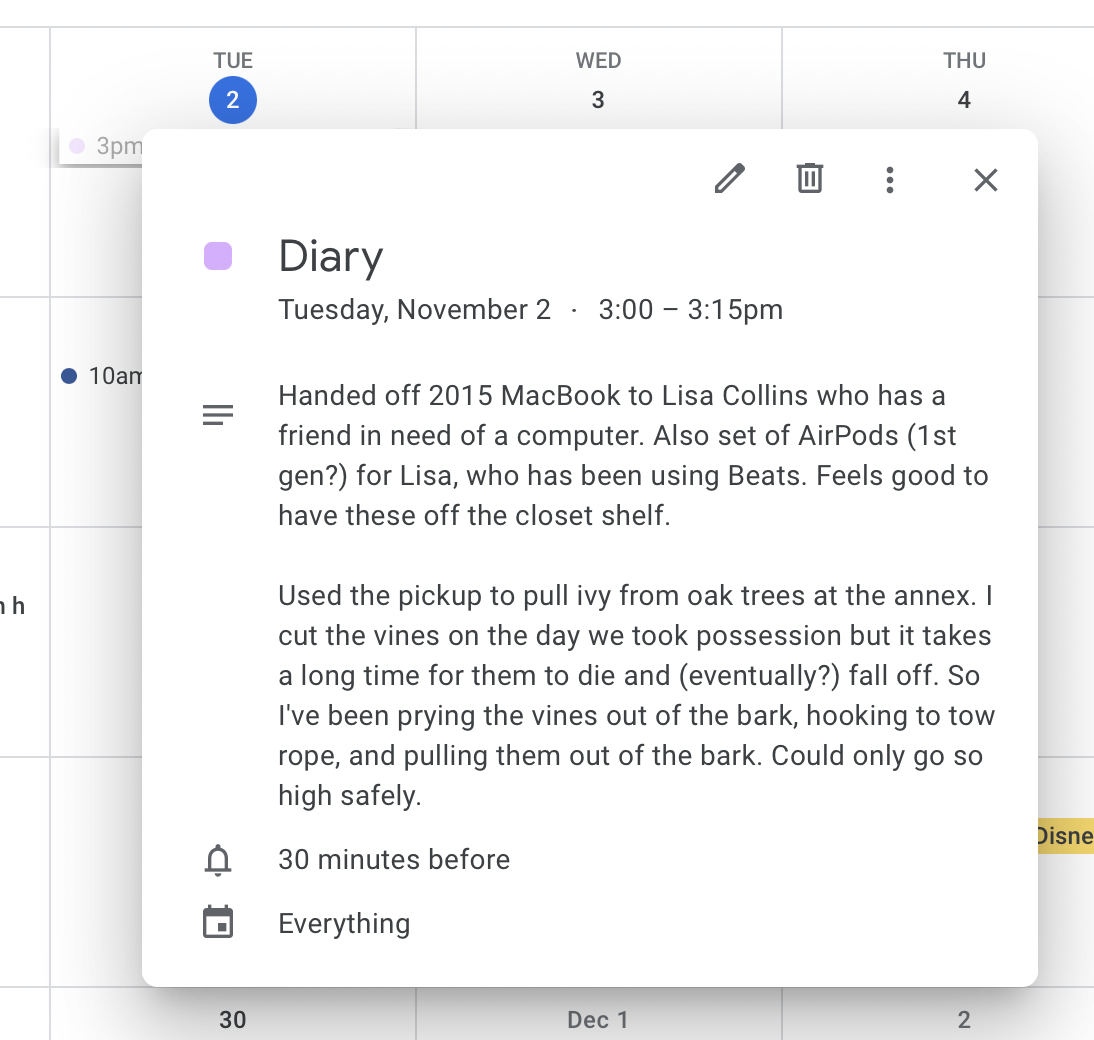
A few days ago it occurred to me Google Calendar would be a good place for this kind of casual note. I slug each entry with “Diary” for easy searching. Of course, I can search for any word or phrase in the entry. Almost no friction here and I’m in Calendar daily.
AirPods 3
I don’t remember when I got my first set of headphones. According to Wikipedia, until the mid-1960s, record companies mixed and released most popular music in mono. From mid-1960s until the early 1970s, major recordings were commonly released in both mono and stereo. In the ’60s The Beach Boys, Frank Zappa and The Beatles were among the first big artists to play around with multitrack recording.
Dolby started showing up in recording studios in 1966 and quadraphonic sound was introduced in the early ’70s but always seemed kind of gimmicky to me.
I know I started buying headphones in the early 70s when I went to work at KBOA. Sennheiser, Bose, you name it… I tried them all. And the good ones were expensive (and fragile). I was never an audiophile. WLS on an AM car radio sounded damned good to 17-year-old me. I never had a Sony Walkman but did get an iPod when they showed up. And the tiny earbuds sounded pretty good to me. Hard to believe it was as recent as 2016 when Apple introduced AirPods. I thought their wired earbuds were fine… until I tried the Bluetooth AirPods. And I’ve had a set ever since.
I hadn’t paid much attention to all the hype about the third generation AirPods but when I saw the launch event a couple of weeks ago, I decided to try a pair. Just to see (or hear, in this case).
To my pedestrian ears, stereo music meant base in one ear, treble in the other, and the vocal track somewhere in the middle. The new AirPods are — for me — living up to the hype. Not sure I can describe what I’m hearing. It really does sound like I’m in a big room (recording studio?) with instruments and singers all around me. It’s a strange feeling. Music is such a perceptual thing it’s difficult to describe. Songs I’ve listened to hundreds (thousands?) of times, sound new and fresh.
Apple will give you chapter and verse on how the new AirPods work but the music I’m now hearing (feeling?) seems impossible. Someone described it as witchcraft.
Stella Leaf Jumps
More Stella joy on her YouTube channel.
Baby dolls carrying away corpses

Posted to reddit by u/throoawyyy